
Rising Tides Episode 1 | Harvard Kennedy School Project on Indigenous Governance and Development Landback Team (Full Interview Transcript)
A rising tide lifts all boats. When tribal nations do well, everyone does well. This webcast series from the Harvard Kennedy School Project on Indigenous Governance and Development showcases stories of excellence in tribal self-governance, drawing from the Honoring Nations family of awardees and decades of Project research. With this series, our vision is to amplify Indigenous-driven solutions that strengthen sovereignty, inspire innovation, and advance community well-being, demonstrating how the exercise of strong tribal governance benefits all.
In this episode, the Landback team from the Harvard Kennedy School Project on Indigenous Governance and Development discusses their research around Indigenous conservation practices. According to their findings, Indigenous peoples are achieving equal or superior conservation outcomes across the globe, and supporting Indigenous-led stewardship is a key strategy to combat biodiversity loss and climate change.
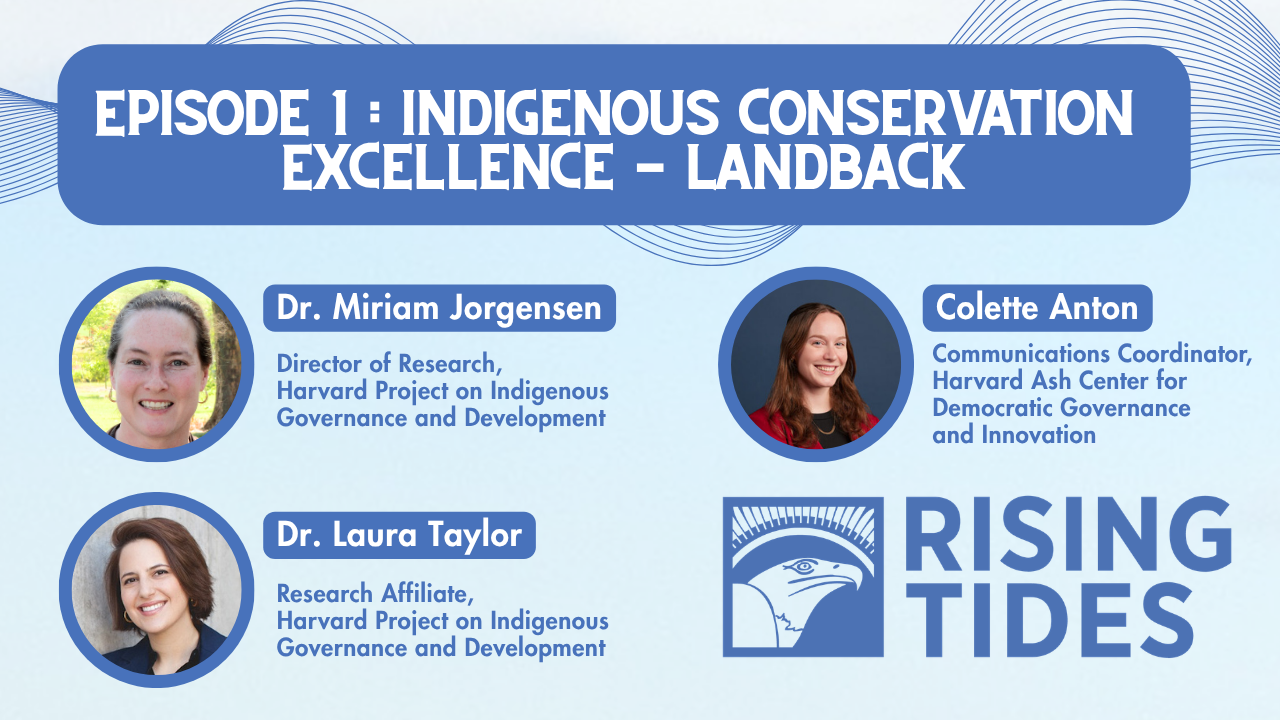
This is Rising Tides Episode 1, Indigenous Conservation Excellence. Hi, I'm Colette Anton, communications coordinator at the Ash Center, and today I'm here with Dr. Miriam Jorgensen and Dr. Laura Taylor of the Harvard Kennedy School Project on Indigenous Governance and Development Landback Research Team. Could you be both please briefly introduce yourselves?
Dr. Miriam Jorgensen: Sure. My name is Miriam Jorgensen. I'm a senior researcher at the Native Nations Institute of the University of Arizona and I also serve as Research Director of the Harvard Kennedy School Project on Indigenous Governance and Development.
Dr. Laura Taylor: And hello, thank you for having us. I'm Laura Taylor and I'm a Research Affiliate with the Harvard Kennedy School Project on Indigenous Governance and Development. I'm also with the department of Environmental Science and Policy at University of Miami's Rosensteel School of Marine, Atmospheric and Earth Science.
Can you both share more about your work with the Harvard Kennedy School Project on Indigenous Governance and Development and why you chose to work on researching Landback initiatives?
Dr. Miriam Jorgensen: I'm just going to take this out of the box because I'm like, you know, so old that I figure I get some primacy here. I've been with the Project since 1989 when I came to the Kennedy School as a candidate for the Master of Public Policy degree, and I met Joe Kalt who was one of the co-founders of the arvard Kennedy School Project on Indigenous Governance and Development which was then called the Project on American Indian Economic Development . . . when the MPPs first come in and professors were . . . talking about their research so we could get a better idea of who we were working with at the school. I was completely stunned to see that there was somebody working on American Indian economic development issues because that is what I came to the school to do, but I was told that “there's nobody here working on it” and so to see him talk about it and be engaged with it was exciting. So, through the two years of my MPP and then a PhD in political economy and government, this has been sort of the focus of my work.
Dr. Laura Taylor: So, I grew up with the Project growing up as an academic and a professional researcher who does community engaged research. And I have been with the Project since 2015 and had a sort of similar, but much later, introduction to the Project which was that I also met Joe Kalt . . . a little bit before then after working for several years in Australia on issues of wage theft from Aboriginal and Torres Strait Islanders in the state of Queensland. And so I came back to the United States to sort of see if anyone else is doing interesting work on this crazy post-colonial situation with Indigenous Nations and other types of legal entities. I found Joe Kalt and I became affiliated with the Project when I started my PhD in Economics at the University of Arizona and the Project was really a natural fit at that point in my career. I was really interested in looking deeply at frameworks that underly societies and especially where societal institutions collide. And you know, the Project is such a unique group in that it was really founded on these principles of working alongside tribal partners to learn from each other and to develop and deploy really practical research for policy and governance.
I always thought if I worked in academia, I wanted to be practical and meaningful in like the real world, not just the theory or theoretical world, and my work as an economist has really followed those principles in that I'm really interested in using the most rigorous and transparent approaches to help make sense of a really complex world. And so this has led to really hands-on and engaged work on complex problems like Landback and the work that the Project does. Aside from issues of wage theft in Australia, I also came to the Project after doing recession forecasting in New York City and continued working on water rights in the western United States. Again, adding data and rigor to a deep understanding of the complex world.
Dr. Miriam Jorgensen: So, Laura’s and my expertise I think meshes really well. I had been doing a lot of work in the mid to late 2010s around issues related to natural resources, federal land management practices, and even related to art and culture and where that intersects with land. So, it became kind of an obvious thing to begin to talk a lot to Laura while she was working on her PhD to start to get a better idea of what her interests were. And because I was my main affiliation was the University of Arizona, we ran kind of in the same circles a bit. But COVID-19 came along and the Project had a unique standing to be a trusted voice in a lot of noise that was happening at the time.
And we began to write a series of briefs for Indian Country particularly aimed at the Department of the Treasury and the Department of the Interior and the responses they were making to the COVID-19 crisis. And we began to gather around us some experts who were working on a wide variety of issues. A couple of them were coming out of the philanthropic sector and they said, "You guys have been doing a pretty good job with this. We're interested if you would be working on some other issues that are on the table for us." And one of the issues they brought to us was saying, "We need some better work going on." They were especially interested in the issues around philanthropy and Landback and the sorts of ways that those intertwined. So bizarrely, it was an engagement in national policy issues and the creation of greater partners that led them to the ask. And for us, you know, Laura's hit on this a little bit with the style of work that the Project does. It's intended to be engaged in the community. It's intended to be responsive. It's intended to bring the best research evidence we can so that Native Nations have the information to wrestle with to make good decisions and build capacity.
So in a responsive fashion, we said, "Sure, we'll work on that," and a couple of papers emerged from that that turned into our broader Landback project.
Miriam, your most recent Landback policy brief was titled “Experts Not Obstacles: Indigenous Conservation Excellence and the Trap of Conservation at Any Cost,” which was also the inspiration for the name of this episode of Rising Tides. Can you tell us more about how you selected this title and how it summarizes your findings?
Dr. Miriam Jorgensen: Sure. I should give a shout out to my co-authors: The lead author is a Native Hawaiian man, Kavika Riley. He was assisted by Blackfeet descendant Britney Nyan, and our other co-author is Monte Mills from the University of Washington, whom many folks will know. And so the four of us together wrote this paper in response to the request that again came from partners and colleagues in some of the Covid-19 work we were doing.
There was this concern around if Landback is going on it's actually related to this other big movement out there which is the increasing movement to try to preserve and protect lands in the United States. You know the Biden 30 by30 initiative was going on. There were other big initiatives to try to pursue greater conservation outcomes from various land-based projects all over the United States, and the tendency that was reported to us from our partners and colleagues was that mainstream foundations tended to do what they had termed “fortress” conservation, we're going to take a piece of land or forest or a natural resource area and put a notional “fence” around it because the best way to protect land is to just let it be. Let it “go back to itself.”
And that really denies millennia of caretaking and relationship that Indigenous people have had with their lands and waters. And so we were challenged to find out if the published peer-reviewed scientific literature pointed in the direction of one approach or the other. So we undertook a scoping review which is kind of a literature review with a very strict analytic lens applied to it. And we began with ~1,500 articles looking at about the past 10 years and found that only 37 of them met our criteria which were that there had to be an Indigenous people involved an Indigenous community. So not just any local community. Anybody who's aware of the debate out there in the international literature between the difference of an Indigenous community (Indigenous to a place) and a local community that may have moved there and have developed in that space knows that debate. So, an Indigenous community that there was a clear description of a conservation practice and that there was a clear description of an outcome because we wanted to be able to really make that connection between Indigenous people acting on the land engaging conservation and seeing an outcome. Out of those 37 articles, 59% of them, just about three-fifths, showed that a superior outcome came from Indigenous conservation practices.
And when we looked kind of under the hood a little bit more for places where there was an expansion of land rights . . . 75% of them showed that there was a superior in those cases. The numbers are small, but we think they're strongly indicative of the fact that the scientific peer-reviewed literature points to the fact that rather than seeing Indigenous people as obstacles to the fortress conservation idea of, “hey, stay away, this is not really your land to look after.” When Indigenous people really engage in their relationship with lands and waters and engage in those conservation practices, they're getting superior outcomes to what, you know, just letting nature be would do. And that's just, I think, a really critical finding.
Very striking findings. Thank you so much for sharing. I'm very interested to hear about what you are doing right now in particular. Could you both share more about the Landback data set you are building and how it plans to blend data and storytelling in partnership with tribes?
Dr. Laura Taylor: Yeah, so I'll jump in to kick this off. The platform that we're building as part of the Landback project is really emerging out of this qualitative and quantitative information – again, very much in line with the Project approach and our individual research approaches. And I should say just as an aside too, Miriam discussed how there were several different types of experts that had been convened for the COVID briefs and that people came with different expertise to weigh in on these difficult policy things. And I know for me when I first came aboard the Landback project, I had just done this significant mapping project at the University of Arizona, mapping the nature, location, and mechanisms of Indigenous land loss at the end of the 19th century and early 20th century in the western United States on a parcel by parcel level. So we had been able to use GIS to visualize the story of western settlement and land encroachment. And so we wanted to use that technology in combination with the deep qualitative information to understand in a granular way the nature of these Landback events, including deep dives into contextualizing regional histories and stories across the United States. Because Landback opportunities are very different (for example, in California) than they might be say in New Jersey. Our nation is very diverse and has very divergent histories, and so we are attempting to be as exhaustive as possible both in understanding differences in these regional histories and laws while also understanding the what, why, and how of Landback and its relevance to tribal government governments and other outcomes including environmental or socioeconomic ones. And so this platform is going to be the foundation to help answer some of these questions in both an empirical and equality way.
Dr. Miriam Jorgensen: I love that description, Laura, because I think it really hits on the kinds of things that the Project does well, which is we can be responsive to questions and needs in Indigenous communities and develop policy responses. We can point people to research that's already out there, and then we can also take this longer view too. And that's the advantage of being in an academic institution and having access to resources that allow us to do that like undergraduate Research Assistants and things like that. So we're trying to build something that's bigger than just a list of news stories but that looks at these other kinds of questions that Laura is raising. And I think that while we have some short-term wins and we're going to talk a little bit more about those in a minute, we're also looking to the longer term to try to think about what are those social science as understandings that we can glean from building a big data set like this and then how does that benefit Native Nations and tribal governments because that's really part of the our vision and goal.
Dr. Laura Taylor: Yeah. And one aside that you just reminded me of too, but it's really important, is that this project also serves as a really great way to mentor and train students, particularly Indigenous students, who might be at Harvard or at other institutions. We've had people come from a very wide range of places and we can bring them in to do this rigorous style of research. We can learn from them and they can learn from us . . . we've probably had about a dozen different affiliated students and individuals over the course of just a few short years of this project and that's been a really important component as well.
That's incredible. Now, I know you mentioned short-term wins, so I want to give you an opportunity to chat about those a little. I hear you also work together on a Landback policy brief focused on “Considerations for Federal and State Landback.” Could you share some of the key findings from that report to close us out?
Dr. Laura Taylor: Absolutely. So, “Considerations for Federal and State Landback, that piece really helps draw together what we call the “low-hanging fruit” for Landback events that sit in this state or federal land type of area. And really that brief was written to present some baseline findings but also to help speak to individuals who might be less familiar with what Landback is and help serve as a little bit of an educational piece of some of these evocative broad questions that are easy to communicate with maps and other visual types of graphics. So, the majority of Indigenous land was encroached upon by western settlers by the end of the treatymaking era in the latter half of the 19th century. But even after reservations were established and land was ostensively contracted over and protected. There were over a 100 million acres that were further lost between 1880 and 1915 as the federal government invested in infrastructure and encouraged western settlement. We know about land loss, but we thought, what happened to that land? If it was ostensively transferred for certain stated goals and aims, did those goals and aims happen? We found in writing that policy brief that approximately a third of what had been reservation land in 1880 and was taken out of reservation status is still just federal land managed and/or owned by the federal government across six different major federal agencies. And making maps of these areas helps beg the obvious question, why did we do that? And are those parcels ripe for land return now?
Dr. Miriam Jorgensen: You know, I think these are the kinds of questions that cause us all to think a little bit harder. Laura and I are both settler scholars. We're not Indigenous. And I think that this kind of information that we can produce ends up being a message that we can take to other non-Indigenous actors out there, and that Indigenous scholars and activists can use to make important points. So, we've seen this work be picked up by folks like Kevin Washburn writing about Landback, and we did it in response to questions raised by several of our colleagues in in the other work. And just want to give a shout out to them, to Jodi Archambault, and to Burton Warrington who really pushed us in this direction and the team that we convened in 2023. That was at the outset of some of the largest exploration of this project. I want to jump on the point that Laura made though about the federal government still owning a lot of this land. And when you think about what that means historically, it means that we kind of have been telling the wrong story about land taken during the “Allotment Era” [1887-1934]. The story that I learned as a kid growing up in South Dakota, as I looked around me at all the sections of land that were out there, is that all this was surveyed because there was this westward expansion push, right? And that it all went to settlers who were going to get their 12 acres and a plow or whatever it is. And yet, the story we see from these maps is that yeah, absolutely some of it went to settlers, but the rest of it was kept by the federal government. And we have it, it has this nice name, “public lands,” but it raises this question of whose lands are those public lands, right?
If you look at the entities within the federal government that control these lands, two of the big ones are the Bureau of Land Management and the US Forest Service. Both of them have congressionally-mandated processes for engaging the public. And important rights holders in that process are Native Nations. And if you think about what the “Experts, Not Obstacles” work says about the land management practices that should be considered by the Bureau of Land Management and the US Forest Service, if they're not going to give the land back, they ought to at least be giving primacy to the stewardship ideas of tribes. And
I think “Experts, Not Obstacles” shows exactly the reasons why. I was doing a lot of work previously on natural resources management and public lands management, and one piece that I did with Len Necefer and Karla Brollier in 2022 for Pew Charitable Trusts looks at exactly this set of questions around what are the decision-making processes on federal public lands. I think that there are real opportunities there, if the land isn't going to be directly given back, for increased stewardship by Native people, and we hope that some of our research which helps both Indigenous and non-Indigenous policy makers, activists, and academics look at these points even harder.
Well, I just want to say thank you both so much for joining us for Rising Tides Episode 1 with Dr. Miriam Jorgensen and Dr. Laura Taylor. Looking forward to what comes next from the Landback Research Team!
Dr. Miriam Jorgensen is a Research Scientist at the University of Arizona Udall Center for Studies in Public Policy and holds the additional titles of Research Director of the University of Arizona Native Nations Institute and Research Director of the Harvard Kennedy School Project on American Indian Economic Development.
Dr. Laura Taylor is a Faculty Lecturer at the University of Miami Rosenstiel School of Marine, Atmospheric and Earth Science, a Postdoctoral Fellow with the National Bureau of Economic Research, and a Research Fellow with the Harvard Kennedy School Project on Indigenous Governance and Development.
Colette Anton is the Communications Coordinator for the Harvard Ash Center for Democratic Governance and Innovation.