
Rising Tides Episode 2 | Jicarilla Apache Nation's Water Sharing Agreement (Full Interview Transcript)
A rising tide lifts all boats. When tribal nations do well, everyone does well. This webcast series from the Harvard Kennedy School Project on Indigenous Governance and Development showcases stories of excellence in tribal self-governance, drawing from the Honoring Nations family of awardees and decades of Project research. With this series, our vision is to amplify Indigenous-driven solutions that strengthen sovereignty, inspire innovation, and advance community well-being, demonstrating how the exercise of strong tribal governance benefits all.
In this episode, Kirin and Jenny discuss the Jicarilla Apache Nation’s innovative water-sharing agreement with the State of New Mexico and The Nature Conservancy. The partnership uses tribal water rights to support endangered fish species, strengthen water supplies during drought, fund community and youth programs, and advance sovereign-to-sovereign collaboration. This approach demonstrates how water agreements can create multiple benefits for Tribal nations, ecosystems, and surrounding communities.
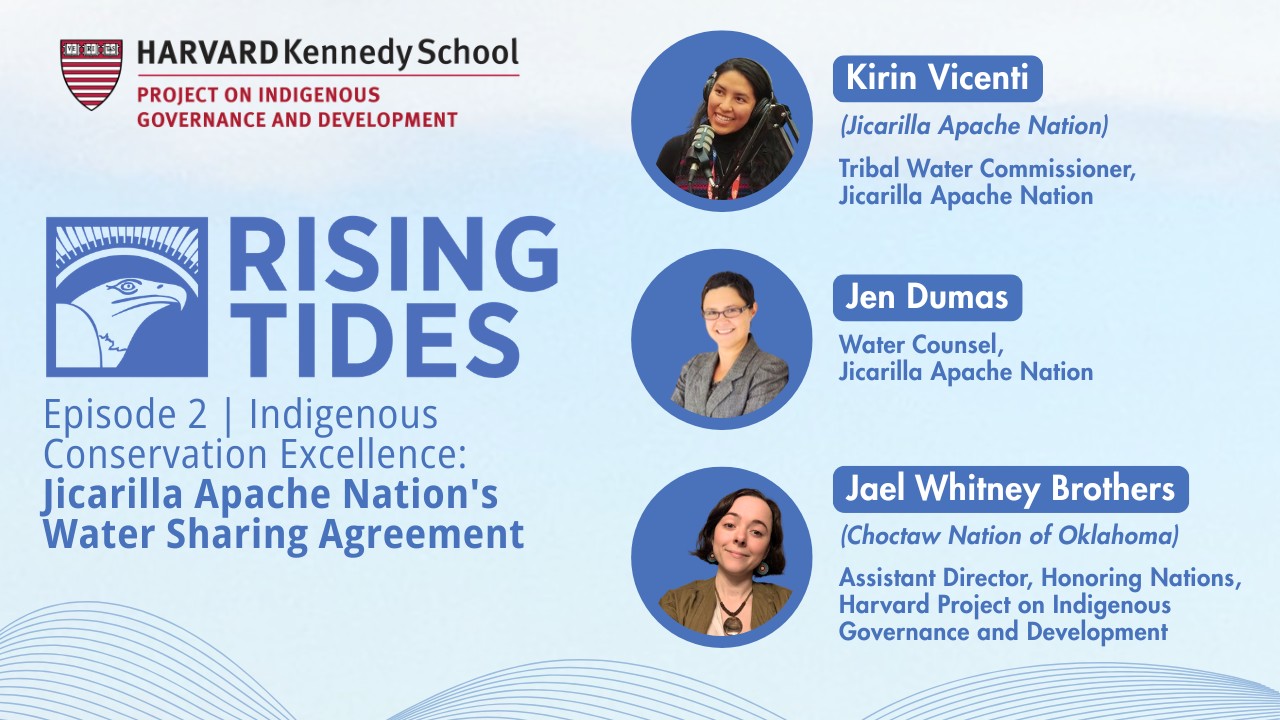
This is Rising Tides. Hello, everyone. My name is Jael Whitney Brothers. I’m a member of the Choctaw Nation of Oklahoma and the Assistant Director for the Honoring Nations Program at the Harvard Project for Indigenous Governance and Development. Today, I am here with two special guests from our 2025 Honoring Nations Awardee, Jicarilla Apache Nations Water Sharing Agreement. Kirin and Jenny, could you please both briefly introduce yourself and share a bit more about your roles?
Kirin Vicenti: [Jicarilla Apache introduction] Hello everybody. My name is Kirin Vicenti. I am Jicarilla Apache, and I'm one of the water commissioners for Jicarilla Apache Nation. And I’m also an inaugural member of the Colorado River Indigenous Youth Advisory Council. In my role, I do a lot of advocacy for our tribal water rights and tribal water rights throughout the Colorado River Basin.
Jenny Dumas: Hello everyone. My name is Jenny Dumas. I am the water attorney for the Jicarilla Apache Nation. I’ve been honored to serve in that role for the last decade now. I am a Native New Mexican and a graduate of the University of New Mexico School of Law—been practicing in the area of Indian law for more than 20 years now.
Great, thank you so much. So, our first question will be for Jenny, and that is: can you walk us through how this partnership got started and explain how it works?
Jenny Dumas: Sure, so the nation has a relatively old settlement—one of the earlier settlements as Indian water rights go, 1992. And the nation, as part of its settlement, receives a pretty large portion of its water as storage water in a couple of facilities that are off-reservation, and that water cannot be delivered to the nation as it stands. And so, the purpose of that settlement water is revenue generation through leasing. So, the nation expressly has the right and the privilege to lease that water for off-reservation use, and that's part of the nation's settlement. So, since 1992, the nation has had a pretty successful water marketing program. But there's a very small market for the nation's water in the place that it's delivered, and historically, that has been to serve oil and gas development, coal-fired power plants—I guess “dirty energy” as folks sometimes say. And as the times have changed and those sorts of industries have changed and shut down and other industries have built up, a few years ago, it turned out that good chunks of the nation's settlement water were going unleased. And there really weren't customers for that water, especially with the shutdown of coal-fired generation. When that happens, the nation would basically get zero revenue for its water of flow downstream, for free. That was a big concern for the nation, one, because not only does the nation's settlement water provide revenue generally for the nation, but it's actually dedicated to water development projects on the reservation. So, those funds are used to do things that improve the water situation on the nation for the people that live there. With less money coming in, we can do less for that very important project—that very important set of unlimited projects, really. And so, we started talking with folks from the state. We started talking with folks from NGOs about what can we do to solve this problem—we need to find a way to put that water to use. And a really smart group of people got together and figured out how we could use existing New Mexico law, mobilize private and environmental-focused funding, and fix this problem and put the nation's water to use for the benefit of endangered and threatened fish species in the river. And so, based on all of those ideas, we created a lease partnership among Jicarilla Apache Nation, the Interstate Stream Commission for the State of New Mexico, and The Nature Conservancy. The Interstate Stream Commission and Nature Conservancy have the right to lease up to 20,000-acre feet of water a year from the nation and to release that water strategically in the river to support threatened and endangered species and to help solidify the state's water supply, especially in times of drought. And so, that's what we do. Every year, the team gets together…not every year, all year. Every year since this lease has been in place, the Interstate Stream Commission has been able to pay for and take 20,000-acre feet of water and to deploy that strategically. But the really interesting part of this from the nation's perspective, it's not just the lease, it's not just selling water and we're done with it. It's a project where the nation continues to participate in decision-making about when and how the water will be released to best support the endangered and fish species—the endangered and threatened fish species, and where there's additional elements that support on-reservation projects and youth development and restoration and all sorts of projects where we're working together with those entities to make a bigger impact than just leasing water.
All right, that's amazing. Thank you so much. For our next question, Kirin, can you tell us more about the larger impacts of this project on the nation?
Kirin Vicenti: Yes, so Jenny touched on some of the things right there at the end, and I think that this lease is a way for our nation to kind of move forward with our lease-building and make it not so that it's just leasing out water, but we're leasing the water, and then there's win-win situations. So, we are able to benefit from that because the lease monies go into water investments for the future. And also, there's a partnership where our youth programs are funded through the lease. There's an outdoor education program that happens every year, and it's called WildCORE. And that's where departments throughout the nation get to gather, and outside organizations like Nature Conservancy or the Interstate Stream Commission get to come in and educate our youth about whatever they're going to educate them about, like cultural education. There was basket making this past year, a lesson about fly fishing and how to measure stream flow. I think that that really engages the community on a broader scale than any other lease would, and I think that, going forward, we want to have more of these leases where, one, it's for an environmental impact and that there's also elements that we can bring in—community engagement and education. I think that this really sets a good precedent for how we can make more leases that are win-wins.
I love that, and I love that it's a win even for the youth of the community, too. That's really cool.
Kirin Vicenti: Yes, definitely.
Awesome. All right, Jenny, could you discuss more about what the impacts of this partnership has been on the larger water community?
Jenny Dumas: Sure, so I think that one challenge that we've had throughout the basin is, there's a large portion of tribal water that is unused currently or undeveloped or that there just isn't a mechanism for the tribe to put that water to use. So, there's a lot of tribal water which is not being used, or it's not benefiting the tribe for whatever reason. For the nation, this water was being leased previously. There was an established lease program. There was a nice statute to fit it into. It was kind of unique in that it addressed that issue of tribal water going unused. Throughout the basin, we have this issue, and so a lot of folks have been saying, “Well, this is the way we need to do it. We take an identifiable source of water. We need to find a use that it can be put to and that it can be dedicated towards and tracked, for an environmental purpose and compact obligations as well.” And so, this transaction is really a model for how we can have folks work together to put water to use for multiple purposes. I think something that Kirin said and one of the most exciting parts of this project is that, as water supplies dwindle, we cannot afford to just get one benefit from it—we can't just lease it and get money. We can't just support the fish. We need to have as many pluses coming out of every single water transaction as possible. And so, this really demonstrates how, just by changing the time of release, you can make an environmental impact for the same water that's being delivered ultimately to a designated location. Thinking more broadly about how we can get that extra benefit from this water to support the environment because the environment is always going to take last in times of scarcity. We have a lot of species of plants and insects and fish and mammals, and they're all suffering right now. And they all take last. And so, if we can take these transactions that benefit governments and people and generate revenue and also turn them into an environmental benefit, that's huge. So, a lot of folks are looking to this to say, “Okay, how can we make our transactions have that broader benefit?” And I think it also is a really great example of how we can use environment NGO money, NGO resources. Because these NGOs—like in this transaction, TNC doesn't just bring money. They've also brought a lot of expertise on the scientific side. They've brought project management expertise. They’ve brought support funding for the state and the nation in making this happen and just more personnel to work on things. Looking to work as partners as opposed to just in parallel with those organizations, I think this is a really great example of that. So, I think a lot of people are looking to this transaction for a lot of different reasons. I'm only touching on a few of the reasons that it's so important and such a great model for changing the way that we've always done things, as we move through incredible drought and unprecedented circumstances.
Yeah, I love what you shared about this shift from the more traditional transactional to more relational environmental lease agreements and how that's setting a new precedent. And so, to that point, Kirin, I would love if you could share more about how this lease agreement aligns with the Jicarilla Apache Nation's long-term sovereign interest as well as cultural values.
Kirin Vicenti: I think that this is the first of its kind—Jenny, let me know if this is not true—sovereign-to-sovereign agreement for the leasing of water from a tribe to a state. I think that this really shows that as sovereigns, we are on the same level where we can make these decisions and make these leases and contracts where we're not just considered an afterthought. We are able to show that we are sovereigns, and we are on the same level. I think that, in terms of cultural values, it's really nice cause we're keeping the water in the river. If we were to have it in a very natural way, then that's how it would stay. But of course, that's not reasonable for these times. Just any way to show that we're respecting the river in this way—I think that when we're able to do this through The Nature Conservancy, through these agreements and leases, then we have to take them, especially during these times, because so many transactions that happen nowadays are merely transactional, from the level of person-to-person or government-to-government. But there's not a reciprocity or transaction that happens with the environment. And I think that is a way to show that we are respecting our cultural values by making sure that this is prioritized and making sure that we do have water for this lease in years to come.
Thank you. Yes, so Jenny, Kirin just shared that this is a sovereign-to-sovereign collaboration. Could you share more about what that means in practice and advice that you might give to other tribes or other organizations looking to build similar types of sovereign-to-sovereign partnerships for their water rights?
Jenny Dumas: Yeah, I think that this transaction has built a true sovereign to sovereign relationship between the state of New Mexico and Jicarilla, at least, you know, in this area. And as Kirin noted, when we when we sat down to negotiate this agreement and hammered through the terms of the contract, one thing that we were looking for was “do we have an example of something the state has already approved where it is making a deal with a tribe in the state?” We have quite a few tribes in New Mexico. The state could not find a single arm’s length transaction between a state and a tribe in New Mexico. The closest thing we have is gaming compacts, which are negotiated, you know, as a whole and it's a completely different process, but in terms of just a transaction with a tribe and the state negotiating for one deal as opposed to, you know, a larger thing like gaming. We could not find a single one and so that was very interesting. Sure, the state does engage in dealings with tribes, but they're really what we call adhesion contracts. We'll give you some money to do this thing, and you sign this paperwork, not an arm’s length sovereign-to-sovereign transaction. And it was really surprising to all of us on the team that that hadn't happened before. I mean, we've been around a long time. We have a lot of tribes in this state, and we have a very active relationship between the state and the tribes. So, the fact that there wasn't that agreement was just a bit surprising and disappointing. And so, I think that in working through those issues, like how are we going to deal with sovereign immunity for both sides? How are we going to deal with insurance requirements? Just really run-of-the-mill contract stuff was difficult because we have two sovereigns involved here that have never done business together. So that was a challenge just from a legal side, but also exciting that we're really changing the way things are done. And I do think that having worked together so closely, really during covid is when we were negotiating this transaction so sort of the new zoom way of doing things, and we ended up spending a ton of time together and really creating some very close relationships among the primary participants in the drafting. And that has led to all sorts of other things. That has led to a much freer exchange of information between the tribes and the state of New Mexico on water issues. It has led to a lot of technical and other support and scientific support from TNC for the nation. And it really is those, I know people say it all the time and it seems silly when you're a lawyer because we don't deal in fufu things, but the relationships are what it's all about. When you create friendships and respectful relationships, that just comes back in spades, and it takes time to do that. So, these sorts of transactions, in addition to the transaction itself, build the relationships underneath that lead to more and new transactions and different ways to support one another. And this transaction has absolutely done that.
That's amazing. Thank you. Great. Kirin, I would love if you could share more, especially from your own personal experience, about how art and creativity can help support environmental advocacy.
Kirin Vicenti: Well, if you know me and if you've met me, you've likely heard me say art changes culture, culture changes people, and people change the world. And I view art as this sort of intentionality with the purpose of creation and to get people thinking and that can come in many forms. One of my roles on the commission is to act as like a public speaker, even on this webcast. And I think that going into like public speaking roles, or anything like that, having a very intentional way of articulating in order to get the point across and to have people think more. So, art can come in that way. And art can also be in the form of like paintings and drawings. And like through this lease and WildCORE program, which I talked about earlier. Our kids are able to engage with our own cultural art, like basket making. And that really can help people connect to the land. And when we connect with the land, we're able to advocate more for it. And environmental advocacy is no different. We want people to engage with it, and in order to make it more accessible and more attractive, we bring art into the spaces because the role of the artist is also to make things more beautiful. And we can see art in our natural environment. We can see art in the home. We can see art in schools and when we're able to connect more with the land, it's easier to do. And I think that especially investing in our youth to be able to engage with these creative practices and engage with the land, then we are planting the seeds for our youth to be environmental advocates and to really care about the reciprocity of everything. Not just people to people interactions, but like this lease, with the environment, and our natural spaces.
I love that it's like art as an invitation to participate more deeply in relationship.
Kirin Vicenti: Yes.
That's great. All right, so for our final question, Jenny, what might success look like for this project, especially in the long term, and what does it look like more broadly for the nation and the San Juan River ecosystem?
Jenny Dumas: Well, I do think if you had asked me that question when we started this transaction, I would say success is what we have right now. Which is keeping more water in the river, supporting the fish, sovereign to sovereign coordination on the scientific and legal level, supporting youth programs, you know, all of that stuff. I would say that was success and we've reached that. But I've been surprised on this transaction that it's so much broader than I had originally anticipated. The benefits just keep coming. So, I look forward to seeing what else comes of this, but I think that it really has changed the way that that we look at lease transactions, at least at the nation. I don't think we're going to be looking at things the way we did before where we just simply say we have some water available, let's exchange it for money on a temporary basis. I think that that's probably not enough anymore. We're looking at bigger and better and different things. How can we help our community? How can we help our youth? How can we make a lasting impact? What extra things can we get out of this? And so, when we're looking at those things, we've already started to look at different pieces that we didn't look at before. So, you know, that's a change. We revised the nation's code and there's different types of things—I mean originally the code written way back in the '90s when the settlement was first enacted was really pretty commercial like let's figure out how we're going to market water—and the guiding principles are changing, you know, on the nation and that is partially due to these sorts of activities. And I think it's also due to engagement of young people with different ways of thinking and a broader perspective than, you know, the original folks that did this. So, I think there's a lot of different pieces there, but you know, true success. I'd like to see this replicated throughout the Colorado River. I'd like to see more tribes put water to use. I'd like to see them get the value of their water when they weren't getting it before. And I'd like to see part of that be to support the river and the ecosystems and the fish and all of that, as opposed to the transactions that we've had in the past. And I think we're definitely setting the stage for that. So true success I think we just change the whole way everything is done and really you know make it really change the narrative so that exchanging water for money is not enough. There needs to be more. We need win-win-win transactions. We need win-win-win-win. We need to pack as much benefit into every transaction as we can. So, I think that's my idea of the next round of success and we could get there and have even more things to do because I think the Jicarilla Apache Nation has always been out there changing the way things are done, being leaders, changing the narrative. And I think Kirin sitting right here, talking about art and music and youth and engaging those resources for big problems that used to be economic or scientific, you know, changing the conversation to make it broader. I think that the sky's is the limit really. So, I look forward to seeing where this all goes.
Yeah, us too at the Harvard Project on Indigenous Governance and Development. One of the big reasons that we wanted to select this program as an awardee for an honoring nations award is because we agree. We want to see this replicated, especially as this sort of sovereign to sovereign power sharing is used to cultivate this reciprocity that leads to greater systems changes and it's just such a cool thing to see in action. So really grateful for the opportunity to have this conversation today. Really excited about getting to share it out with our audience. And thank you both so much for your contributions.
Kirin Vicenti is an Indigenous musician, activist, and Tribal Water Commissioner from the Jicarilla Apache Nation.
Jenny Dumas is life-long New Mexican and founder of and principal attorney for Dumas Law Office, LLC. She currently serves as water counsel for the Jicarilla Apache Nation.
Jael Whitney Brothers (Choctaw Nation of Oklahoma) is the Assistant Director for the Honoring Nations program at the Harvard Kennedy School Project on Indigenous Governance and Development.